

Product labels carry ingredients, allergen information, barcodes, batch codes and the brand itself. When one of those is wrong, or a barcode will not scan, the usual fix is a corrected label or an over-label that covers the error, and it is usually needed before stock can move.
This guide covers the decisions that make an urgent label order go smoothly: the label stock, whether you need an over-label that hides what is underneath, the cut format, barcode checks and the handover. Food labelling rules are set by the Singapore Food Agency. EZ Print prints the label content you approve and does not review it for regulatory compliance, so confirm the wording with whoever is responsible for it before you send the file.
Which Label Stock Suits the Product?
Choose the label face by where the product lives. Paper labels suit dry, indoor packaging such as boxes and bags. Vinyl or synthetic film suits labels that meet moisture, refrigeration, oil or frequent handling. Clear film suits glass and clear bottles. Then choose the adhesive for the surface and how long the label must stay on.
| Label face | Moisture | Typical finish | Good for |
|---|---|---|---|
| Paper | Dry use | Gloss or matt | Boxes, bags, seals, dry goods |
| Synthetic film | Resists moisture and handling | Matt or gloss | Chilled drinks, sauces, cosmetics |
| Clear film | Resists moisture | Clear gloss | Glass jars, clear bottles |
| Blockout label | Depends on the face | Matt or gloss | Covering an existing error |
- Adhesive. A permanent adhesive suits a product label. A removable adhesive suits a promotion. Low-tack suits a surface that must be left unmarked. Say what the label is going onto: card, glass, plastic, a curved bottle or a chilled surface.
- Lamination. A matt, gloss or soft-touch laminate protects the printed face. A matt laminate can also make a label easier to write on.
For more on choosing materials, see the custom sticker and label printing guide.
When Do You Need a Blockout Over-Label?
Use a blockout over-label when the new label sits on top of printing that must not show through, such as a wrong barcode, an old price or an outdated ingredients panel. A standard white label can let dark print underneath show through. A blockout label has an opaque layer that hides it. Ask for blockout when you send the brief.
- Measure the area to cover. Make the over-label a little larger than the panel or barcode it hides, so small placement errors do not leave an edge showing.
- Check the surface. An over-label on a curved bottle or a textured carton needs a face and adhesive that can follow the surface.
- Test one. If you can, apply one sample over the error and check it under the lighting where the product is sold or scanned.
Should Labels Be Kiss-Cut on Sheets or Cut as Singles?
Kiss-cut labels are cut through the face only, so they peel from a backing sheet or roll that stays whole; this suits applying many labels by hand or by machine. Die-cut singles are cut through the backing too, so each sticker is a separate piece, which suits handouts and gift bags. Say which format your team will use.
- Kiss-cut sheets or rolls. Several labels sit on one backing sheet or on a roll. Tell us how the labels will be applied, by hand or with a labelling machine, because a machine needs the roll wound a particular way.
- Die-cut singles. Each sticker is cut to its shape through the backing. These are handed out or packed individually.
- The cut line. Draw the cut path as a vector line in a named spot colour (often called “CutContour”), set to overprint, on its own layer. Add bleed outside the cut line if the background runs to the edge.
A contour path or cutting die is made once and kept on file, so a reorder of the same shape does not need it again. The stickers and labels page lists the label formats that are quoted.
How Do You Check a Barcode Before Printing a Replacement Label?
Generate the barcode as vector artwork from the correct number, print it dark on a light background, keep the clear quiet zone on both sides, and do not shrink it below the size your retailer asks for. Then scan a printed proof with the kind of scanner that will read it in use. A barcode that looks right on screen can still fail.
- Quiet zone. Leave clear space on both sides of the bars. For an EAN-13 symbol, GS1 specifies a quiet zone of 11 bar widths on the left and 7 on the right; follow GS1 guidance for your symbol type and size.
- Colour. Black bars on white is the safest choice. Many scanners use red light, so red bars can read as blank, and reversed (light-on-dark) barcodes can fail.
- Vector, not a screenshot. Supply the barcode as a vector graphic, not a low-resolution image copied from a screen.
- Size. Ask your retailer or distributor for their minimum barcode size before you shrink a barcode to fit.
The guide to barcode and QR code checks goes through proof testing in more detail.
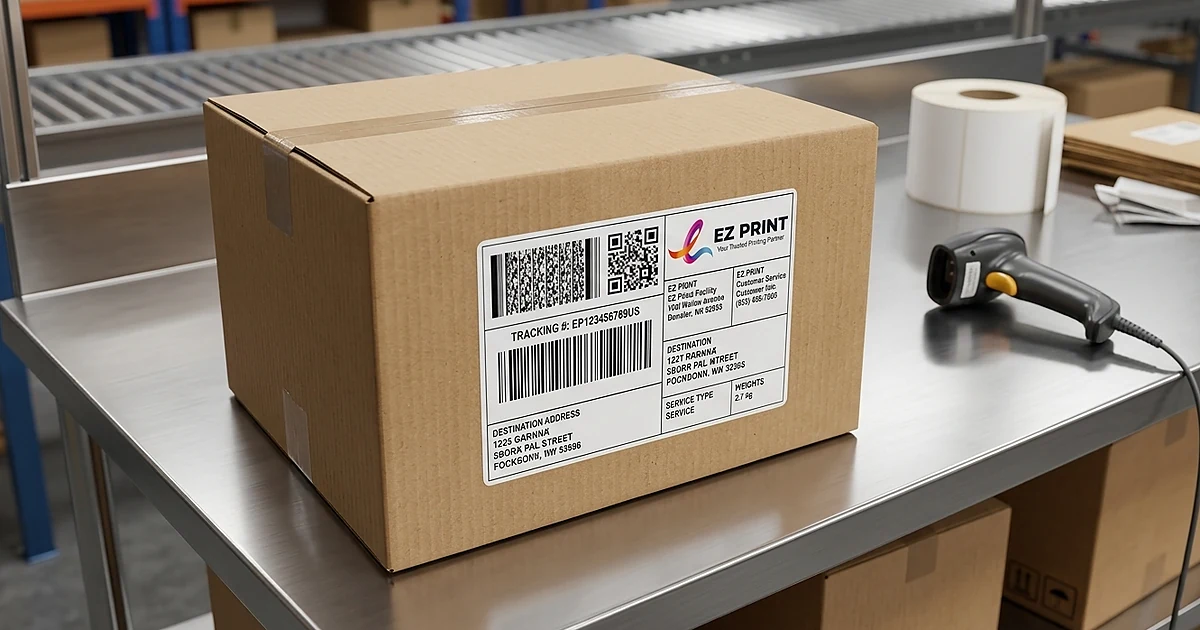
Worked Example: Barcode Over-Labels for an Imported Drinks Shipment
Hypothetical illustration. Figures are assumptions for explanation, not a real transaction or advice. A drinks importer learns that the barcode on 2,000 newly arrived bottles will not scan at a retailer's intake. The example follows the decisions the importer makes in order: the correct code, the over-label, the format, the brief and the handover.
Step 1: Confirm the correct code. The importer confirms the correct product number with the brand owner and generates a new EAN-13 barcode as vector artwork, black on white, with its full quiet zones.
Step 2: Specify the over-label. The importer measures the old barcode panel and chooses a 40 × 20 mm rectangular over-label. Because the bottles are chilled, the brief asks for a synthetic blockout label with a permanent adhesive.
Step 3: Choose the format. Staff will apply the labels by hand, so the importer asks for kiss-cut sheets: 50 labels per sheet, 40 sheets for 2,000 labels.
Step 4: Send the brief. The importer fills in the quote builder with the size, stock, format, quantity and required date, and sends it by WhatsApp with the PDF and its cut line attached. Artwork, stock and capacity are confirmed. Timing is agreed when the job is confirmed.
Step 5: Arrange the handover and test. The importer gives the warehouse address, a named recipient and a mobile number, and confirms the delivery point and contact with the warehouse. On arrival, staff apply one label and scan it before labelling the rest.
Frequently Asked Questions
Is same-day printing available for custom labels?
Same-day and urgent printing available. Subject to artwork approval, payment, print type and production availability. Timing confirmed per job. Standard turnaround is 7–14 working days. The label stock, the cut format, the quantity and whether the cut line is ready all affect what can be fitted.
What is the difference between a cut line and a printed border?
A printed border is part of the design and prints on the label. A cut line is a guide path for cutting and is not printed. Put the cut line on its own layer in a named spot colour set to overprint.
How does a blockout label hide what is underneath?
A blockout label has an opaque layer behind the printed face, so dark printing underneath does not show through. Make the label slightly larger than the area it covers.
Can labels be cut to an irregular shape?
Yes. Labels can be cut to a custom outline from a vector cut path. Keep the shape simple enough to peel cleanly, and avoid very thin points that can lift.
How are finished labels delivered or collected?
Island-wide courier delivery is available to your outlet, kitchen or warehouse. Confirm the delivery point and contact with the venue or organiser. Collection by arrangement — tell us when you would like to collect and we will confirm the time.
What Should Be Checked Before Sending an Urgent Label Order?
Before sending an urgent label order, confirm the label content with whoever owns it, then the stock, adhesive and format, whether you need a blockout over-label, and the cut line. Check any barcode on a printed proof. Settling these first keeps the order to one round of questions and lets your team apply the labels as soon as they arrive.
- Label wording and codes confirmed by the person responsible for them.
- Label face and adhesive chosen for the surface and conditions.
- Blockout requested if the label covers existing print.
- Format chosen: kiss-cut sheets, rolls or die-cut singles.
- Cut line on its own layer in a named spot colour; bleed added.
- Barcode generated as vector art and tested on a printed proof.
To start, send your brief through the request a quote page or read how availability is confirmed on the same-day printing page.
Same-day and urgent printing available. Subject to artwork approval, payment, print type and production availability. Timing confirmed per job.