

A printed folder with a bound document inside is still how many proposals are handed over across Raffles Place, Marina Bay and Tanjong Pagar. When the figures in a pitch change late, the folder and the deck have to be produced together, on a schedule that leaves little room for a wrong specification.
A folder is not a flat print. It is cut from a sheet of card to a shape, creased and then glued or locked, and the cutting tool decides how quickly it can be made. This guide explains the decisions that matter when time is short: the folder shape, the stock, the card slit, the binding of the document inside and the artwork set-up.
Why Does the Folder Shape Decide the Schedule?
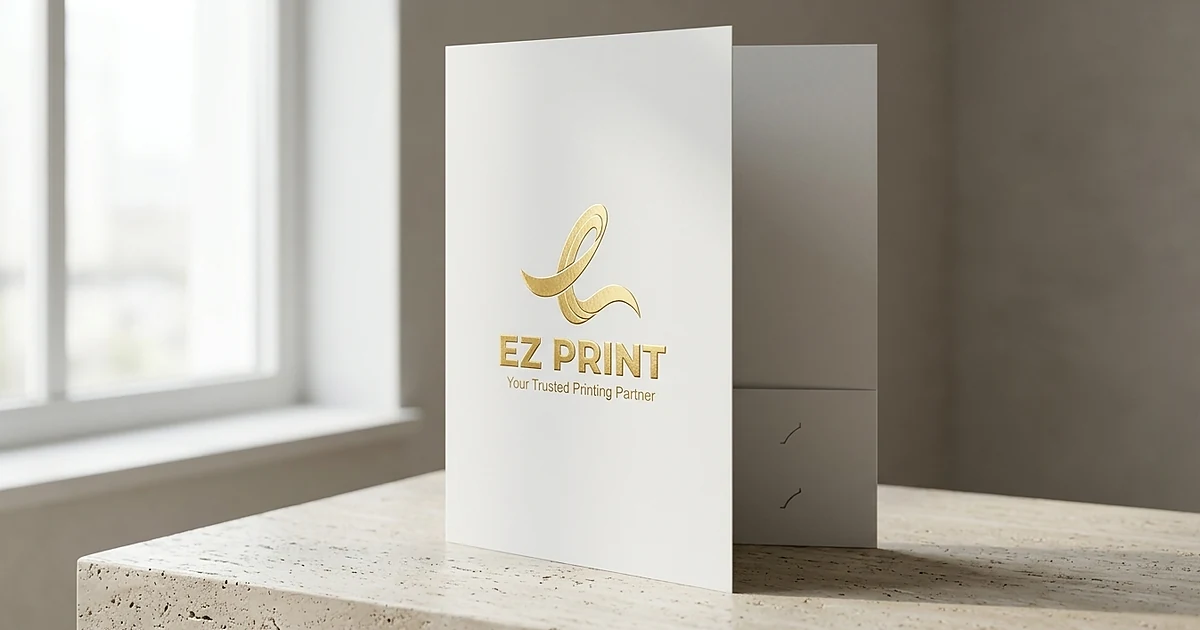
A folder is cut from a flat sheet by a cutting die, and a new shape needs a new die made before anything can be cut. Ask whether a standard folder template can be used for your size; a custom die takes longer. Choosing a standard A4 pocket folder is usually the most useful single decision on an urgent folder job.
A standard A4 presentation folder is about 220 × 307 mm when finished, cut from a flat net of roughly 460 × 320 mm. A die made for a shape is kept on file with the approved artwork, so a reorder of the same folder does not need a new one.
- Standard template. Ask whether a standard folder template can be used for your size; a custom die takes longer. If a template fits, you design onto it and the cutting step is already settled.
- Custom shape. Angled pockets, curved flaps, a spine for a thick document or an unusual size all need a new die. Plan these on the standard schedule. Standard turnaround is 7–14 working days.
- Glued or interlocking pockets. Glued pockets are fixed and sturdy. Interlocking pockets fold into slots without glue and can be supplied flat. Ask which construction the chosen template uses.
If you need a folder with a name card slit, say so in the brief. The slit is part of the template, so it has to be agreed before the artwork is placed.
Which Card Stock and Lamination Suit a Presentation Folder?
Presentation folders are usually printed on 300–400 gsm matt or gloss art card. The card is creased before folding, and the outside face is usually laminated so the spine and pocket edges survive handling. Lamination also helps a dark design, where a fold through solid colour can otherwise crack and show white paper fibres.
A few points to settle when you choose the stock:
- Weight. Around 350 gsm is a common choice: stiff enough to hold a document upright in the pocket, but still easy to crease and fold.
- Lamination. Matt lamination gives a soft, low-glare finish; gloss makes colours look stronger. Either protects the outside of the folder from scuffs.
- Matching stationery. If the folder sits alongside letterheads and envelopes, compare colours across the set before you approve. The guide to letterhead, envelope and folder compatibility covers what to check.
How Should the Pitch Deck Inside the Folder Be Bound?
A document inside a folder is usually Wire-O bound or saddle-stitched. Wire-O opens completely flat and takes any page count, which suits a longer deck that readers write on. Saddle stitching suits a short document, takes pages in multiples of four and adds little thickness to the pocket. Choose by page count and by how the deck will be used.
| Wire-O bound deck | Saddle-stitched booklet | Loose sheets | |
|---|---|---|---|
| Page count | Any page count | Multiples of four | A few pages |
| Opening | Opens completely flat | Opens nearly flat | Single sheets |
| Cover | Clear or frosted front, card back | Printed card cover | None |
| Thickness in pocket | Thicker; check the pocket | Slim | Slim |
| Good for | Board papers, longer proposals | Company overviews | Quotations, one-page summaries |
If the bound deck is thick, check that the folder pocket can take it, and ask about a folder with a spine or gusset if it cannot. The booklet printing page has more on binding choices.
How Should Folder Artwork and the Die Line Be Set Up?
Place the artwork on the folder template and keep the cut and crease lines on their own layer, in a named spot colour set to overprint, so they guide cutting without printing. Add 3 mm bleed beyond every outer edge and flap, and keep text and logos clear of the creases and the card slit.
- Separate layers. Keep the artwork on one layer and the die line on another, so the cut path can be read without being printed.
- Name the die-line colour. Use a spot colour with a clear name, such as “CutContour” or “Dieline”, set to overprint. Cut lines and crease lines are often drawn in different styles; follow the template’s key.
- Bleed. Extend background colour 3 mm past every outer edge, including the pocket flap and any tabs.
- Keep clear areas. Keep text away from creases and from the card slit, where a card will cover it. Check the slit size against a 90 × 54 mm card.
The presentation folders page shows the folder formats that are quoted.
Worked Example: Folders and Pitch Decks for a Marina Bay Meeting
Hypothetical illustration. Figures are assumptions for explanation, not a real transaction or advice. An advisory team in Marina Bay needs 25 folder sets with a bound deck for a meeting that has been brought forward. The example follows the decisions the team makes in order: the folder, the deck, the files, the brief and the delivery.
Step 1: Choose the folder. The coordinator asks whether a standard A4 single-pocket template with a card slit can be used, and accepts it rather than a custom shape.
Step 2: Choose the stock. 350 gsm art card with matt lamination on the outside.
Step 3: Choose the deck binding. The deck is 24 landscape pages. The team chooses Wire-O with a frosted front cover and a card back, and checks that the bound deck will fit the pocket.
Step 4: Prepare and send the files. The designer places the folder artwork on the template, keeps the die line on its own layer and exports print PDFs for the folder and the deck. The coordinator fills in the quote builder with both specifications, the quantity and the required date, and emails the brief with the files attached. Artwork, stock and capacity are confirmed. Timing is agreed when the job is confirmed.
Step 5: Arrange delivery. The coordinator gives the office address, a named recipient and a mobile number, and confirms the delivery point and contact with the building reception.
Frequently Asked Questions
Is same-day printing available for presentation folders?
Same-day and urgent printing available. Subject to artwork approval, payment, print type and production availability. Timing confirmed per job. Standard turnaround is 7–14 working days. A folder on a standard template has a far better chance of fitting a short schedule than one that needs a new die.
What is the difference between interlocking and glued pockets?
Interlocking pockets fold into slots and hold without glue, so the folders can be supplied flat. Glued pockets are fixed in place and feel firmer. Ask which construction your chosen template uses.
Can a folder have a foil logo on an urgent schedule?
Foil stamping needs its own die and an extra production step, so plan it on the standard schedule. For an urgent run, consider a printed version of the logo instead.
How thick a document will a folder pocket hold?
A flat pocket suits a slim document. For a thick deck or many loose sheets, ask about a folder with a spine or gusset, and give the page count and paper weight so the capacity can be checked.
How are finished folders delivered or collected?
Island-wide courier delivery is available to your office or meeting venue. Confirm the delivery point and contact with the venue or organiser. Collection by arrangement — tell us when you would like to collect and we will confirm the time.
What Should Be Checked Before Sending an Urgent Folder Order?
Before sending an urgent folder order, confirm that a standard template fits, the stock and lamination, the card slit, the deck binding and whether the deck fits the pocket. Then check the artwork against the template, with the die line on its own layer and bleed on every edge. Settling these first avoids the questions that hold up urgent jobs.
- Standard folder template confirmed for your size, or custom die planned on the standard schedule.
- Stock and lamination chosen.
- Card slit position agreed and checked against a 90 × 54 mm card.
- Deck binding chosen, and the bound deck checked against the pocket.
- Die line on its own layer in a named spot colour; 3 mm bleed on all edges.
- Delivery address, recipient and mobile number ready.
To start, send your brief through the request a quote page or read how availability is confirmed on the same-day printing page.
Same-day and urgent printing available. Subject to artwork approval, payment, print type and production availability. Timing confirmed per job.